Drip irrigation not working: a UK checklist from the tap to the emitter
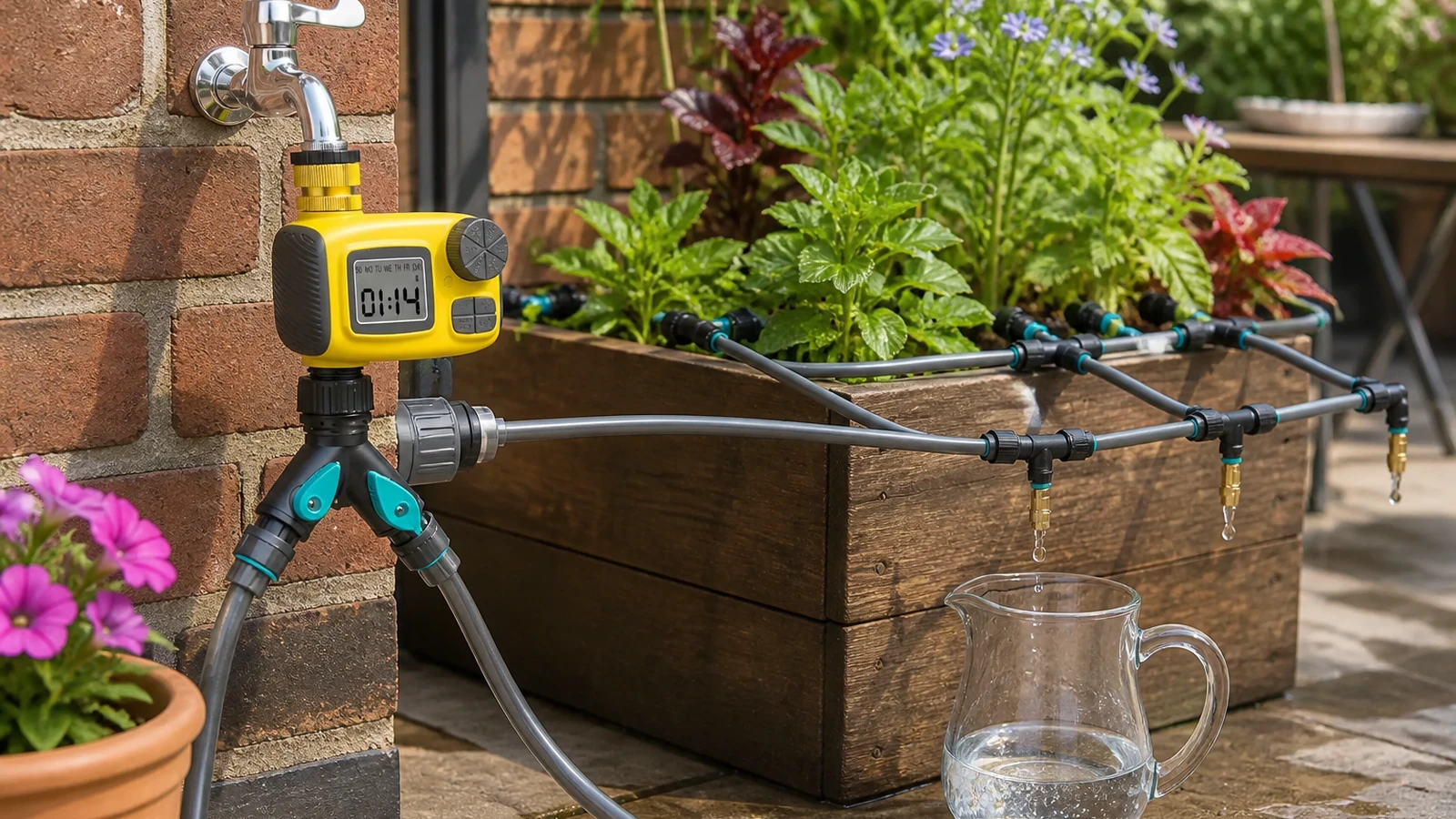
Dry patio, leaving for Cornwall, 90 seconds with a jug before you blame the box.
Do not start at the greenhouse. Put a jug by the tap, set the timer to manual or override, and find where the water stops. Hozelock and Gardena put the same two checks first: tap on, alkaline cells. Bound & Barrow then split the line — one dry head, a weak stretch, or the whole run dead. Stop when the break appears and jump. You do not need all seven blocks.
- Outdoor tap fully open; indoor stopcock open.
- Timer click — fresh alkaline AA, not zinc-carbon, not rechargeable. Listen or feel the valve. Catch water at the timer outlet with the line off.
- One Y-leg — shut one side, run the other. Both open is not a diagnostic.
- First emitter — one minute into the jug, at compost, not at a leaf.
- Last emitter — the same timed minute.
Dry at the tap: stay on the tap. Water at the timer, nothing at the first head: a joint or a closed cap, not a dead box. First minute wet, last minute a smear: flow to share, not a return.
| What you see | Where the jug stopped | Go to |
|---|---|---|
| Whole system dry | Nothing at the tap; click but dry outlet; or no click | Whole system dry |
| Wet path at the tap stack | Weep at thread, washer face or Y | Leak at tap, timer or Y |
| Fitting weeps or blows off | Push-fit fails a tug, or the tube walks out | Push-fit weeps or blows off |
| One plant dry | First jug wet; that brass head dry | One dry brass emitter |
| Far end dry, both beds weak | First jug good, last jug poor; worse with both Y-legs open | Far end dry / both beds weak |
| Timer “dead” | Tap on, fresh alkaline in, still no click — or a cracked body | Timer not working after tap and batteries |
| It runs, leaves are wet | Fine spray, humid glass, compost barely marked | Working but misting greenhouse foliage |
Water butt without a pump: the water-butt post. Lawn sprinkler: the comparison post. Full first install: the install checklist. Holiday soak-test you should have run last week: the holiday post.
Whole system dry — nothing coming out
If there is no water at the outdoor tap, the box is not the problem. Open the tap fully, then the indoor stopcock that feeds it. A half-closed valve looks like a dead timer. Hozelock’s fault tables: valve opens, no water — turn the tap on. Gardena’s electronic timers say the same in the first row. Do that before you touch a fitting.
If the tap is live and the timer is silent, change the cells. Two AA alkaline batteries. They are not in the box. Zinc-carbon sags under a solenoid. Rechargeables sit around 1.2 V; Hozelock’s manuals tell you not to use them, because the valve can open and then fail to close. Fit fresh alkaline, check polarity, use manual or override. You should hear or feel a click.
With the line off the outlet, catch the next click in the jug. Water here means the valve is working. Dry after a real click: grit in the inlet or a programme that never opened — go to the timer block, not a new hose. No click after new alkaline, tap confirmed on: only then is the timer body in the dock. Until then this is setup, and a return will not fill the patio. After a battery change the clock can drop out; stay on manual for this test. Do not buy a regulator or a filter while the tap is still off. Bound & Barrow’s tree starts at the source for a dead line; on a UK outdoor tap that source is the stopcock and the cells.
Leak at the tap, timer or Y-splitter
A wet collar is not a wet bed. Dry the stack and watch one cycle. Note whether the weep is on the male thread, the washer face, or the Y.
The timer is stated for ½″ and ¾″ BSP. Most UK outdoor taps are ¾″ BSP; the male thread is about 26.5 mm across and looks like an inch on a ruler. It is not an inch. Older 1″ bib taps, leftover ½″ fittings, and the odd imported GHT thread will not seat. PTFE will not invent the missing millimetres. Take the timer collar to a garden centre or ironmonger and buy a BSP adaptor that matches your tap to the timer inlet — typically ¾″ BSP female onto a ¾″ or ½″ male, or a reducing bush for the odd size. Offer it on the closed tap; it should start on the thread by hand.
- Seat the inlet washer flat.
- Wrap PTFE on the male taper thread only, clockwise as you look at the end of the thread; keep tape out of the waterway.
- Hand-tighten until snug. Do not put a spanner on plastic.
If the Y weeps, the same rules apply: washer in, threads matched, fingers only. The fix is the correct adaptor and a seated washer, not another 30 m of tube.
Push-fit weeps or blows off
Push-fit on ½-inch tube fails when the end is oval, ragged, or not home. Depressurise. Cut a few millimetres off square with a pipe cutter, not kitchen scissors. Dip the end in warm water — not boiling. Push to the internal stop, then tug. If it walks out, it was never seated.
The blue ring is a release, not a lock-nut. Press the ring in and pull to take a joint apart. Do not twist it like a hose collar. Mixed-brand fittings with a slightly different outside diameter will weep even when they look home; recut and use the matching push-fit from the same run. A joint that blows off under a full tap is almost always an unseated pipe. Walk the line after the recut and tug each T-piece once.
One dry brass emitter
If the first jug filled and one brass head is dry, Bound & Barrow’s tree calls that a blocked emitter, not a failed main. Unscrew the twist cap. Rinse grit and compost. If the orifice is furred, soak the brass in dilute white vinegar, rinse, and refit. Open a fraction — a bead at compost, not a jet. Check you did not close that head last week to stop a puddle.
If it still will not pass water, swap it for a spare brass emitter of the same twist-cap type and keep the blocked one as a winter clean-out. That is a how-to on one plant. If you have added pots beyond the twenty in the box, buy more emitters for those stations; do not replace the whole ½-inch run. A second kit is only relevant if you need another twenty planting points on a second tap, not because one tomato bag is dry.
Far end dry / both beds weak
First jug good, last jug poor, is not a dead timer. The tap is sharing itself. Twenty open brass heads on a long ½-inch run feed the nearest pots and starve the greenhouse. Both Y-legs open at once does the same: two beds, half the pressure.
The Y-splitter is already on the tap. Use it as a zone valve, not a flow-doubler. Shut one leg fully. Run the other for the timed minute and watch the far emitter. Then reverse. Bound & Barrow treat a weak stretch as a run asking too much of one supply; sequential watering is the fix already in your hand. Close spare brass you are not using.
Do not buy a second kit to “balance” two beds that can take turns on the same clock. A second timer is only worth thinking about if you insist on two schedules at the same hour. For this morning: one leg, then the other, then pack the car.
Timer not working after the tap and the batteries
Only come here when the outdoor tap is fully open, the indoor stopcock is open, and fresh alkaline AA cells are in. If you skipped that, go back to the isolation list. Hozelock and Gardena both refuse to diagnose a timer until those two are done.
A click and water at the outlet with the line off means the timer is working. The fault is downstream — a shut Y-leg, an unseated push-fit, or brass closed to a stop. Still no click: rinse the inlet; grit from a new tap will hold the valve shut. Reset the programme after the battery change and try manual again.
If the housing is cracked, or last winter’s ice split the body on the tap, replace the timer. IP65 means rain on the casing, not frost-proof. Hozelock and Gardena both tell you to store controllers frost-free. A split body is a like-for-like tap timer on ½″ or ¾″ BSP — not another £85.53 kit of hose and heads. Buy the timer last, after the tap and the alkalines, never as the first guess.
- Take the timer indoors before the first hard frost.
- Drain it and remove the cells so they cannot weep in the compartment.
- Fit it again in spring with new alkaline cells, not the pair left in the shed.
Working but misting greenhouse foliage
If the timer clicks, the jugs fill, and the glass is wet, the system is not watering the crop. Brass heads open from a bead into mist, then a jet. On a tomato bag that mist is a disease risk, not a feature. The RHS advice on tomato blight is to keep greenhouse foliage as dry as possible. Blight needs hours of wet leaf; a warm, still house after an evening fog is exactly that. The RHS watering guidance says the same: water the base, not the leaves.
Close each twist cap until you have a bead on the compost, a hand’s width from the stem. Lower any riser spraying the canopy. Run in the morning so a splash can dry. Seedling humidity is a separate line, or a can — do not open fruiting-row heads into mist. This is user adjustment. There is nothing to buy. Keep the return; twist the cap.
No kit yet, or isolation shows you never commissioned one — cells not fitted, stack never seated, coil still in the box — that is a tap-fed ½-inch job, not a spare. The DripSystem UK 30 m ½-inch drip kit with tap timer is £85.53. It is not the first answer if the patio is already plumbed and dry this morning.