If your greenhouse has a garden tap: a mains drip line for grow bags and pots (and when to skip the £300 solar kit)
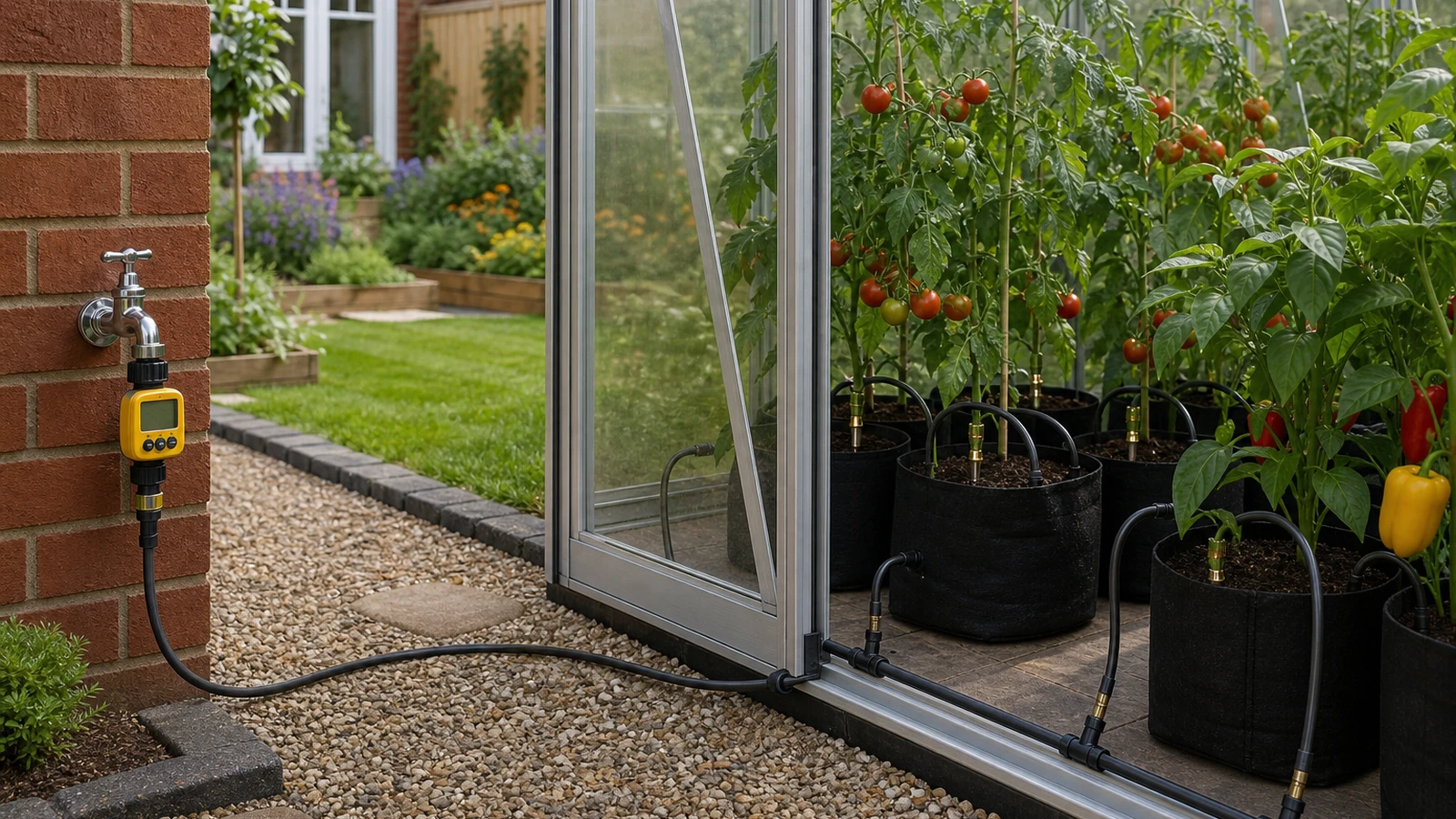
Before you buy anything, do the tap test. Attach a hose to the outdoor garden tap, open it fully, and time a 10-litre watering can. If the can fills in well under a minute and the jet would knock a light pot sideways, you have pressurised mains and a drip line will run. If the tap only dribbles, if it is fed from a water butt with no pump, or if there is no outdoor tap at all, stop: a mains kit will sit there dry. That single check decides whether you need a tap-fed drip line for grow bags and pots, or whether you should look elsewhere.
The greenhouse this kit is for
This is for a typical backyard aluminium or timber greenhouse of about 6×8 ft or 8×6 ft, stretching to 8×10 ft if you have packed it with bags and pots. That is a house-garden structure: a short walk from the back door, a path you already water with a hose, and a tap on the wall or at the side of the house. It is not a polytunnel. A tunnel on an allotment is a different job — longer runs, often no house tap, and a water butt as the only supply.
Inside a 6×8 or 8×10 the crop is almost always containers: tomato grow bags on the staging or the floor, pepper and chilli pots, a cucumber, perhaps aubergines and basil. Rain never reaches the compost. On a bright June day the bags dry from the top while you are at work. The job is keeping those bags evenly moist without a can every evening. Count the containers first. A well-stocked 8×6 often holds eight to twelve bags and pots; an 8×10 holds more if you use both sides of the path. Twenty outlets is enough for that house, not for a commercial tunnel.
Thirty metres from the house tap
The useful length is not the width of the greenhouse. It is the walk from the outdoor tap to the first grow bag. Many UK houses put the garden tap on the back wall, with the greenhouse against the rear fence or at the far end of the path. Ten metres of thin greenhouse tubing will not cover that run and still leave laterals for every pot. Thirty metres of ½-inch main line will.
Lay the ½-inch hose from the tap, along the path or the fence, in through the door or a low vent, then down one side of the staging. Cut in T-pieces where the bags sit. You need one pressurised run that actually arrives; inside the house the remaining tube is only for short droppers. If the greenhouse is hard against the tap, coil the spare. Narrow micro-tube over twenty metres loses pressure before the last tomato bag. A ½-inch main on outdoor tap pressure is why the far emitters still drip.
Twenty emitters: one per pot, two on a thirsty bag
The kit includes twenty emitters. Use them as stations. One emitter per ordinary pot — a 10- to 20-litre chilli, pepper or herb pot — is enough if you seat the spike in the compost and open the drip to a slow, visible bead. A standard tomato grow bag with two plants is the exception: those bags are shallow, they dry from both planting holes, and a fruiting cordon drinks hard under glass. Put two emitters on that bag, one by each plant, both aimed at the compost, not at the stem.
Twelve pots and four tomato bags is twelve singles plus eight on the bags — twenty stations, and the house is done. Cap unused T-pieces if you have fewer containers. Keep the line inside the greenhouse. After the first timed run, the compost should be damp to a finger’s depth, not sitting in a puddle in the tray. Grow bags have no reserve; they swing from dust to soup and split fruit. Two well-placed drips beat one flood.
Drip the compost — never wet the crop
Point every emitter at the compost surface. Do not open them into a mist or a fan over fruiting plants. The RHS advice on tomato blight is blunt: infection needs prolonged surface wetness on the leaves. Greenhouse crops are safer than outdoor ones, but wet foliage in a warm, still house still gives the pathogen the hours it wants. Keep the leaves dry. Water the root zone.
First Tunnels put drip irrigation at the base of the plant for tomatoes, aubergines and peppers for the same reason: water goes to the roots and the leaves stay dry. Overhead spray belongs on seed beds or dense leafy crops, not on cordon tomatoes in a 6×8. If an emitter has a spray setting, close it to a drip on every fruiting bag and pot. Cucumbers and chillies take the same rule: wet compost, dry canopy, vents open so the house does not sit in a fog. Time the cycle for early morning. Evening watering that leaves the house closed and humid overnight is the pattern blight and grey mould enjoy. A tap timer makes that morning run possible on a work day.
The £45 Palram pack: cheap, short, and often no timer
The Palram Canopia drip pack, commonly sold at about £45, looks like the obvious greenhouse extra. It typically gives you 10 m of drip line, 16 droppers, a tap adaptor and a few T-connectors. It is a fair in-house kit if the greenhouse sits next to the outdoor tap and you will turn the water on yourself. It is not a run from the house. Ten metres is the inside of an 8×10 plus a little slack — not the path from the back wall. Sixteen droppers is tight once two tomato bags take four stations.
That pack often arrives without a timer. You still have to remember the greenhouse at 6 a.m., or you leave a tap dripping and hope. Buying the Palram droppers plus a separate tap timer, extra ½-inch hose, and more emitters usually lands near the price of a complete 30 m kit. Use Palram if the greenhouse is against the tap, you have fewer than sixteen pots, and you are home to switch it. Use a 30 m ½-inch line with a timer and twenty emitters when the tap is at the house and the bags are at the fence.
When to skip the £300 solar kit
Solar pump kits exist because plenty of UK plots have no outdoor tap. A water butt beside a greenhouse or an allotment with only harvested rain needs a pump, and a solar panel is one way to drive it. WaterMate, Irrigatia and Halls sell into that gap; a complete solar-and-pump bundle often sits around £300 once you have the panel, the controller and the drippers.
If your tap test already showed a strong garden tap, you do not have that gap. Mains pressure is already there. A tap timer does the automation. Spending three hundred pounds on a solar pump to lift water you could take from the tap is kit for a job the plumbing already does. Skip it. Keep the solar budget for the plot that has no tap. The mains drip line assumes the tap is on and the pressure is real. The solar pump assumes a reservoir and no mains. Do not mix them up.
Fitting the line and living with the timer
Fit the timer on the outdoor tap first, then the ½-inch hose, then the greenhouse laterals. Leave the tap open; the timer is the valve. Use fresh alkaline batteries at the start of the season. Run a short test cycle before you trust a holiday. Walk the line for kinks at the door and for drips that mean a T-piece is not fully home.
Start with a morning run of twenty to thirty minutes in settled warm weather, then check the bags. Increase time before you increase frequency. In a closed 8×10 in a heatwave you may need a second short cycle; in a dull May week, almost nothing. If the bags are light and the leaves flag at noon, add time or a second emitter on that bag. Before winter, disconnect the timer, drain the hose, and store emitters so frost does not split them.
When not to buy this kit
Do not buy it for a polytunnel, or if the only water on the plot is a butt, or if the greenhouse is fifty metres from the house. Do not buy it to mist or spray fruiting crops — that works against the RHS guidance on wet foliage. Do not buy it as a cheaper Palram if what you need is ten metres beside the tap and you will be there to turn it on. Do buy it when the tap test passes, the greenhouse is a 6×8 to 8×10 in the garden, the tap is up to 30 m away, and the crop is bags and pots that need a drip on the compost while you are out.
If your greenhouse already has a pressurised garden tap, the 30 m ½-inch kit with timer and 20 emitters (£85.53) will reach from the house tap to the bags. If you have no tap — only a water butt or an off-grid allotment — do not buy this kit; it will not run. Look at a solar pump system (WaterMate, Irrigatia, Halls) instead.