One tap, two raised beds: split a 30 m ½-inch line — ten twist-cap emitters per bed
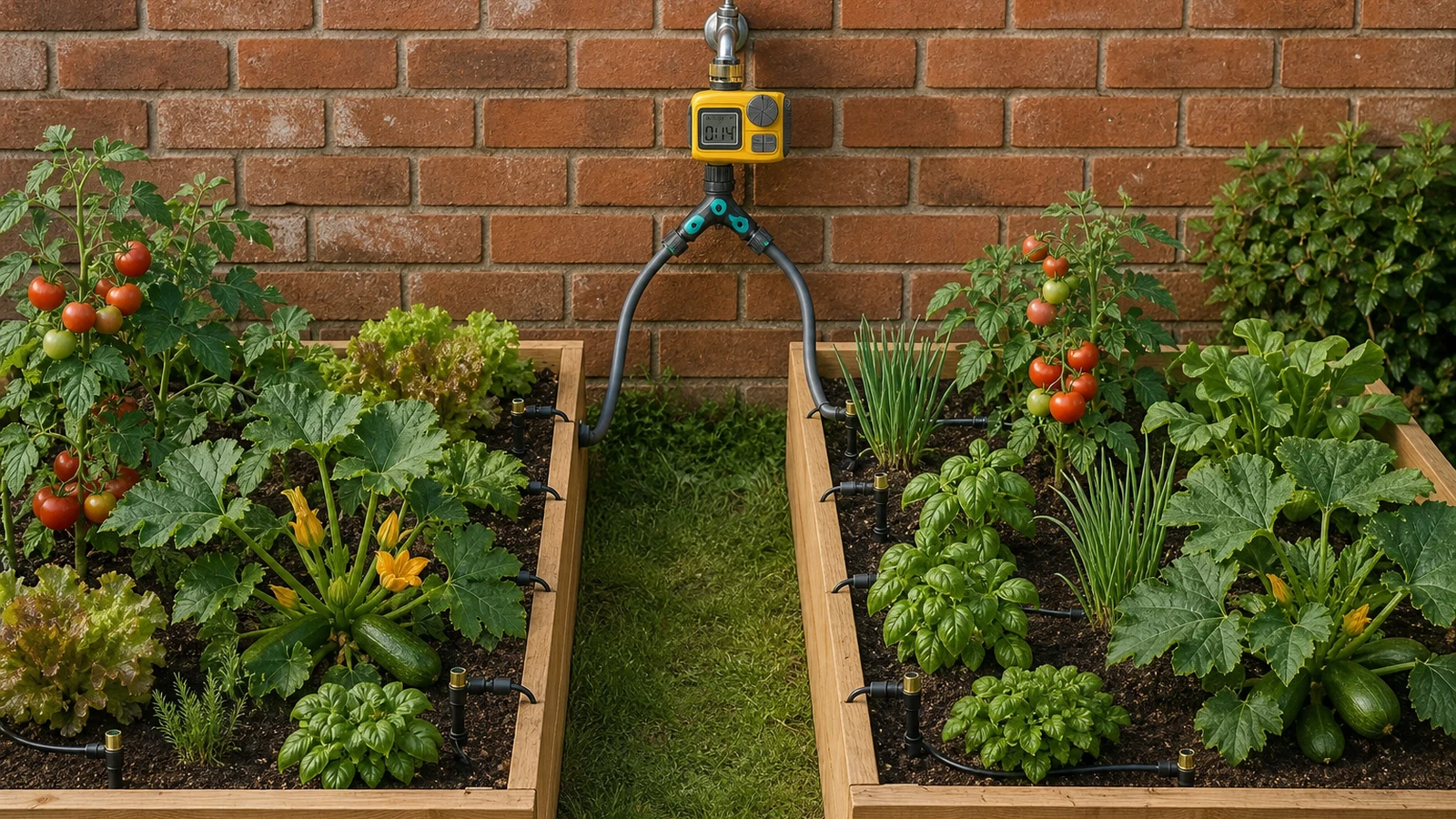
Two typical UK raised beds — about 1.2 × 2.4 m each — need one pressurised outdoor tap, a timer, a Y-splitter and twenty twist-cap emitters on ½-inch pipe. They do not need two taps or a bag of 4.6 mm tees. The DripSystem UK 30 m kit at £85.53 is 30 metres of ½-inch in total, including the feed from the house. Split that coil at the Y. Do not run the whole 30 m down the first bed and then branch: the last emitters starve and the first bed floods. Leave the tap ON. Both beds share the same clock unless you shut a Y valve. Twist the caps for tomatoes versus onions — one timer does not give you two programmes.
                         [Outdoor tap ON]
                                |
                          [Tap timer]
                                |
                          [Y-splitter]
                         /             \
                   (valve)           (valve)
                      |                 |
                 ½-inch run A      ½-inch run B
                      |                 |
     +----------------+--+  path  +----+----------------+
     |  e   e   e   e   e |        |  e   e   e   e   e |
 1.2m|                    |        |                    |
     |  e   e   e   e   e |        |  e   e   e   e   e |
     +--------------------+        +--------------------+
              2.4 m                         2.4 m
            BED 1                         BED 2
         ~10 emitters                  ~10 emitters

  30 m TOTAL = feed from tap + both bed runs + a little spare.
  Split at the Y. Do NOT run 30 m as one snake, then branch.
Split the 30 m at the Y — do not daisy-chain then branch
Measure from the tap to the nearest bed, then across to the second. That feed uses part of the 30 m. What remains is split between the two runs, not copied twice. The beds themselves only need a few metres of ½-inch along each timber; the rest of the coil is the walk from the house. Unrolling the full 30 m through bed one, then teeing into bed two, looks tidy and waters badly. Split at the Y so each bed gets a ½-inch run of similar length. End-cap each run, flush before you plug, and walk every joint on a short manual run.
Two laterals along the 2.4 m length — or one loop — with an emitter at each plant station is enough. Ten points suit spaced hungry crops: tomatoes, courgettes, peppers, aubergines, a row of beans. That is not a salad carpet. Dense onions, lettuce or herbs will share stations. The timer’s ½-inch / ¾-inch BSP fitting suits many UK outdoor taps; some taps need a separate adaptor. Two AA alkaline batteries are not included. This kit wants mains pressure; a water butt usually needs a pump.
Same clock unless you shut a Y valve
When the timer opens, both legs run. This is not a dual-outlet computer with a veg programme and a herb programme. To water only bed one, shut the valve on the other Y-leg. If both should water, leave both valves open and balance with the twist caps. Put fruiting crops on one bed and dry-end crops on the other if you can, then shut a valve after rain. You still have one clock; you are choosing which pipe is live.
Twist-cap emitters: soil, not foliage
The twenty brass emitters are planting stations, not pressure-compensating drippers with a published litre rate. Twist more open on tomatoes and courgettes; twist nearly closed on onions and herbs. Aim at the soil at the base, not the leaves. A slow drip into the root zone is the job. Mist across the canopy is spray, and it wets foliage the RHS tells you to keep dry. Wet courgette leaves invite powdery mildew; erratic moisture on tomatoes is linked to blossom end rot and splitting. After the first automatic cycle, a puddle at one station and dust at another means twist the cap — do not invent a new run time.
May to September: RHS logic, not a minute card
There is no honest fixed duration for this kit. The RHS advice is to water thoroughly, not too often; to check moisture at depth, not the top centimetre; and to avoid a blind once-a-week routine. Raised beds dry faster than in-ground soil — finger-test after warm, windy weather. Prefer morning. Water the soil at the base. Mulch. Pause after rain. This mains kit is for a pressurised outdoor tap; use stored rainwater in cans where you can.
| Window | What the plants are doing | Twist-cap on this kit |
|---|---|---|
| May | Young plants and new transplants need consistent moisture. Establishment watering for tomatoes and courgettes. Raised-bed mix dries faster than open ground — check at depth, not the crust. | Crack each station open enough to wet the root zone. Watch the soil, not the clock. Keep water off the foliage. |
| June | Leafy salads want evenly moist soil. Onions, shallots and leeks need water while they establish and in very dry spells. Courgettes want constant moisture through to harvest. | Onion and herb bed: nearly closed. Fruiting or leafy bed: more open. Same timer unless you shut a Y valve. |
| July–August | Tomatoes, aubergines and peppers want consistent moisture through flowering and fruiting — erratic watering is linked to blossom end rot and splitting. Courgettes: keep the soil moist; do not wet the leaves (powdery mildew). Runner beans need moisture for pods to set. Mulch. Skip after heavy rain. | Thirsty fruiting plants more open; herbs and onions still throttled. Aim drip at soil. If a cap is misting, close it until it drips. |
| September | Outdoor tomatoes still fruit; irregular watering still splits fruit. Growth slows as rain often returns. Check the soil and ease off when the bed stays damp. | Re-check caps after a wet week. Do not leave mist on. Shut a Y-leg if one bed is finished and the other is still cropping. |
Treat herbs like the dry end of the bed, not like courgettes. If both beds are a mix, twist plant by plant on the same ½-inch run and the same clock.
This kit versus Gardena MDS 13455
Gardena’s Micro-Drip-System starter for raised beds (13455) is a different architecture: 35 pressure-compensating inline drippers, 13 mm plus 4.6 mm pipe, a Master Unit with a pressure-reducing valve, and a bag of micro-fittings. The timer is extra. This kit is the other job: timer in the box, ½-inch the whole way, about ten twist-cap stations per bed, and a Y that splits two runs from one tap. Twenty stations is not thirty-five. UK list prices for 13455-class kits move around and exclude a timer. Ours is £85.53 as a complete tap-to-beds box.
| DripSystem UK 30 m kit | Gardena MDS 13455 | |
|---|---|---|
| Timer | In the box | Extra — buy separately |
| Pipe | 30 m of ½-inch, split at the Y (total, not per bed) | 15 m of 13 mm plus 15 m of 4.6 mm |
| Delivery | ~10 twist-cap emitters per bed (20 in the kit) | 35 pressure-compensating inline drippers |
| Pressure | No PRV in the box; twist the cap | Master Unit / PRV in the set |
| Fittings | Push-fit ½-inch on both runs | Micro-fittings, reducing tees, pegs and plugs |
| Best fit | Two raised beds, one tap, timer included, spaced hungry plants | Dense planting, drip-only PC points, MDS expandability |
This kit is for two raised beds and one tap, a timer in the box, about ten planting points per bed, twist caps instead of 4.6 mm tees, and 30 m covering the walk from the house plus both runs. Choose MDS if you want drip-only PC drippers, a PRV in the set, around 35 drip points on 13 mm plus 4.6 mm, and you will buy a timer separately.
A Saturday you can finish
- Confirm a pressurised outdoor tap and whether you need a BSP adaptor. Fit the timer with fresh alkaline AA batteries. Leave the tap ON once the joints are sound.
- Fit the Y after the timer. Cut two ½-inch runs of similar length. Do not unroll the whole 30 m as one snake.
- Place about ten emitters per 1.2 × 2.4 m bed at plant stations, outlets aimed at soil. End-cap both runs. Flush, then plug. Manual-run and walk every joint.
- Twist tomatoes and courgettes more open; twist onions and herbs nearly closed. Set a conservative morning programme, then finger-test at depth. Skip after rain. Shut a Y valve if only one bed should run.
Get the 30 m two-bed kit — timer, Y-splitter and 20 twist-cap emitters, £85.53