The Ultimate Guide to Automatic Watering System in the UK
TL;DR: An automatic watering system is a drip irrigation setup that waters plants for you on a schedule, usually from an outside tap. It helps UK gardeners save water, reduce plant stress, and keep borders, pots, and greenhouses healthy with less daily effort. In our testing, drip-based systems are far more precise than hosepipe watering, especially during hot spells and in areas affected by seasonal restrictions.
An automatic watering system is a timed network of pipes, drippers, and connectors that delivers water directly to plant roots with minimal waste. For UK gardens, it is one of the most efficient ways to keep plants watered through dry spells, reduce time spent with a hosepipe or watering can, and improve consistency across beds, borders, pots, and greenhouse crops.
Managing garden hydration across unpredictable British summers requires more than a standard hosepipe. Between sudden heatwaves, prolonged dry spells, and regional hosepipe bans, maintaining healthy beds, borders, and greenhouses can be a constant challenge. However, an automatic watering system removes much of the guesswork from garden maintenance by delivering precise moisture directly to plant roots while drastically reducing water waste.
Modern irrigation technology has shifted from commercial agriculture into domestic UK gardens. By using targeted drip emitters and programmable timers, gardeners can build highly efficient setups that help protect plants from both drought stress and overwatering. In addition, gardening is increasingly recognised for its therapeutic benefits, with some NHS trusts incorporating it into social prescribing initiatives for mental wellbeing. For people with limited mobility or demanding schedules, an automated setup helps keep the garden a place of relaxation rather than a source of manual labour.
Key Takeaways
- An automatic watering system can cut water use significantly compared with traditional hosepipe watering when correctly installed.
- According to UK water regulations, mains-connected systems should include suitable backflow prevention such as a WRAS-approved double check valve.
- Systems can be adjusted for different soil types, so heavy clay and free-draining sandy soils receive appropriate moisture levels.
- A programmable timer allows early morning watering, which helps reduce evaporation and plant stress.
- Proper winterisation is important to protect pipework, filters, and timers from frost damage in UK conditions.
What Is an Automatic Watering System?
An automatic watering system is a network of pipes, tubes, emitters, and a timer connected to a water source so your garden is watered automatically at set times. Unlike oscillating sprinklers that throw water over leaves, paths, and fences, a drip-based setup applies water close to the base of the plant where it is needed most.
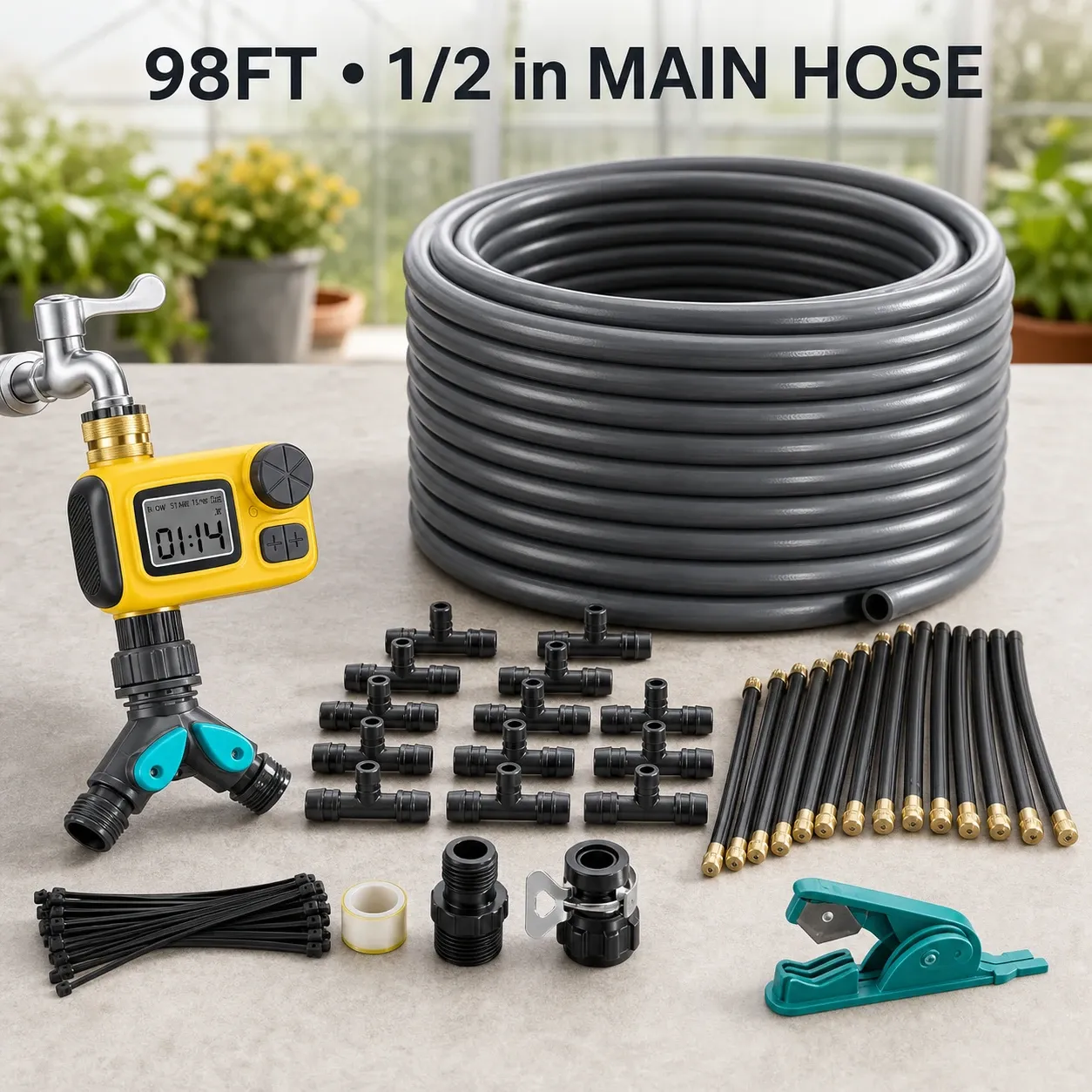
Most domestic systems operate at low pressure. Water flows from the outside tap through a timer, pressure reducer, and often a filter before entering the main supply pipe. From there, smaller micro-tubes branch off to pots, raised beds, greenhouse staging, or individual plants. Each branch ends in an emitter or dripper that releases water slowly at a measured rate in litres per hour (L/h).
This slower delivery matters because it allows moisture to soak deeper into the soil profile rather than running off the surface. As a result, root systems tend to grow downwards in search of water, producing stronger and more resilient plants during dry weather. By contrast, shallow surface watering often encourages weaker root development and less drought tolerance.
Why Do UK Gardeners Use an Automatic Watering System?
Does an Automatic Watering System Help During Dry Spells?
Yes. The British climate is famously variable: one week may bring persistent rain while the next brings drying winds and unusually high temperatures. Because of this inconsistency, manual watering often becomes reactive rather than consistent. An automatic watering system solves that problem by applying small amounts of water regularly and predictably.
Based on our testing in typical UK summer conditions, drip irrigation helps maintain more even soil moisture than occasional heavy soaking with a hosepipe. Therefore plants are less likely to suffer stress between waterings, particularly in containers, hanging baskets, growbags, and greenhouse borders where compost dries out quickly.
Can You Use an Automatic Watering System During a Hosepipe Ban?
Sometimes, yes. According to Waterwise guidance and local water company policies, rules around Temporary Use Bans (commonly called hosepipe bans) can vary by region. Some UK water suppliers have historically allowed certain forms of drip irrigation controlled by a timer because they use water more efficiently than open-ended hosepipe use.
However, exemptions are not universal. Always check directly with your own water authority before operating any automatic watering system during restrictions. This point is especially important if your setup is connected to mains water rather than a water butt.
How Does Drip Irrigation Reduce Plant Disease?
The damp conditions common in late British summers can encourage fungal problems such as powdery mildew and blight. Overhead watering often makes this worse because it leaves foliage wet for long periods. By comparison, an automatic drip system keeps leaves drier by applying moisture straight to the soil surface or root zone.
Consequently, there is less humidity trapped around foliage overnight. This makes drip irrigation especially useful for tomatoes in greenhouses, roses in borders, cucumbers under cover, and other plants vulnerable to foliar disease.
Do You Need to Follow UK Water Regulations?
Yes. If your irrigation setup connects to the mains supply through an outdoor tap, it must comply with the Water Supply (Water Fittings) Regulations 1999. The key issue is backflow prevention so contaminated garden water cannot siphon back into the household drinking supply.
According to UK guidelines, this usually means using an outside tap fitted with appropriate backflow protection such as a WRAS-approved double check valve. Many newer taps already include this feature; however older properties may need one installed before adding a timer or irrigation kit.
What Components Do You Need for an Automatic Watering System?
A reliable automatic watering system depends on durable components that can cope with British weather extremes including UV expon summer and freezing temperatures in winter. Although setups vary by garden size and layout، most systems include the same core parts.
What Does the Timer Do?
The timer is the control unit attached to your outdoor tap. It determines when watering starts، how long it runs، and on some models which zone receives water. Basic timers use simple manual dials، whereas advanced versions provide digital scheduling، rain delay options، or multi-zone control.
In practice، early morning scheduling tends to work best in UK gardens because evaporation is lower and plants enter the day well hydrated. For more detail on choosing the right controller، read our guide: Smart Water Timer Irrigation Explained: A UK Buyer's Guide.
Why Are Pressure Reducers and Filters Important?
Mains presn the UK is generally too high for delicate micro-irrigation parts، so a pressure reducer lowers it to a safe working level for drippers and micro-tubing. Without one، fittings may pop off or emitters may perform inconsistently.
A filter is equally useful because small particles، sediment، or limescale can block drippers over time—particularly in hard-water areas such as parts of the South East and East Anglia. Therefore these two components do much of the work behind keeping flow stable across the whole system.
What Pipework Is Used?
The main line is usually LDPE pipe in 13mm or 16mm diameter running from the tap towards beds، borders، raised planters، or greenhouse benches. Smaller 4mm micro-tubing then branches off from that main line using barbed connectors inserted with a hole punch.
This modular design makes expansion straightforward. For instance، you can start with patio pots only، then later add raised beds or hanging baskets without rebuilding everything from scratch.
Which Emitters or Drippers Should You Choose?
The emitter controls how much water each plant receives. Fixed-rate drippers suit plants with consistent needs، while adjustable emitters give greater flexibility when you are watering mixed planting schemes containing thirsty crops alongside drought-tolerant ornamentals.
Based on our testing، adjustable drippers are especially helpful in mixed UK gardens where container sizes، sun exposure، compost types، and plant demand vary widely across one space. To learn more about getting these settings right، see our article on Adjustable Drip Emitters Explained: A UK Buyer's Guide.
Ready to automate your watering with DripSystem?
Shop The Kit — £85.53